
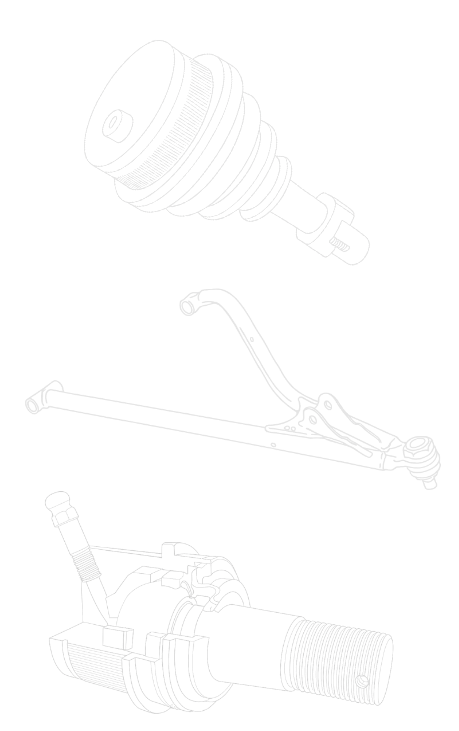
Inner Tie Rods Explained: The Hidden Link Behind Steering Precision
The Inner Tie Rod, also known as a Rack End, is the critical link between the steering rack and the Outer Tie Rod End. Although hidden beneath the steering rack boot, it directly transfers steering input to the wheels while allowing the linkage to articulate with suspension movement.
Unlike a fixed steering link, an Inner Tie Rod must handle repeated axial loads while accommodating changes in steering and suspension angles. Any excessive play, dimensional variation, or loss of articulation can affect steering response, alignment stability, and long-term durability.
For performance and modified vehicles, the Inner Tie Rod deserves the same engineering attention as more visible steering components.
What Makes an Inner Tie Rod Critical to Steering Performance?
The steering linkage operates as a continuous mechanical system:
Steering Rack → Inner Tie Rod → Outer Tie Rod End → Steering Knuckle
The Inner Tie Rod must transfer steering force while maintaining controlled articulation throughout the suspension's operating range.
Inner and Outer Tie Rods Must Work Together
Upgrading the Outer Tie Rod End alone does not necessarily improve the entire steering system. The Inner Tie Rod remains part of the same load path, and its joint stiffness, articulation, length, and connection to the steering rack all influence overall steering behavior.
This becomes particularly important when a vehicle is modified with:
- Lift or lowering kits
- Larger tires
- Increased suspension travel
- Modified steering knuckles
- Aggressive steering angles
These changes can increase joint articulation and alter the original steering geometry.
Tie Rod Geometry and Bump Steer
The effective length and position of the Tie Rod influence how the steering linkage moves relative to the suspension.
When the steering linkage and suspension components follow different arcs, suspension compression or rebound can create unintended Toe changes. This is known as Bump Steer.
For modified vehicles, correcting bump steer requires more than simply installing a stronger component. The relationship between the Inner Tie Rod, Outer Tie Rod, steering rack, and suspension geometry must be considered as a complete system.
What Makes a Performance Inner Tie Rod More Reliable?
A performance Inner Tie Rod requires more than increased material strength. Reliability depends on the interaction between material selection, joint design, dimensional accuracy, manufacturing processes, and validation.
Material and Heat Treatment
High-load steering applications may use alloy steels such as SAE 4140 Chromium-Molybdenum Steel for the ball stud, providing a combination of strength, toughness, and wear resistance.
However, material grade alone does not determine performance. Quenching & Tempering or localized Induction Hardening can be applied to achieve the required balance between hardness, fatigue resistance, and toughness.
The objective is not simply to make the component harder, but to ensure it can withstand repeated loading and impact without premature wear or fracture.
Precision Manufacturing and Tolerance Control
Critical dimensions such as ball stud geometry, effective length, thread tolerance, housing dimensions, and joint preload directly affect steering performance. Excessive variation can change articulation torque, introduce unwanted play, or alter steering geometry.
For this reason, dimensional accuracy must be controlled throughout production—not only verified on the final part.
Conclusion
An Inner Tie Rod may be hidden beneath the steering rack boot, but it plays a fundamental role in steering precision and durability. Its performance depends on more than fitment—it is determined by geometry, joint design, material properties, manufacturing precision, and validation.
At Motorpro, whether you are a global brand seeking low-volume agility or a builder tackling the world's toughest terrain, Motorpro engineers the confidence you need to dominate the track or the trail.
Ready to eliminate steering deflection and master your chassis geometry? Contact Motorpro to explore our specialized rack ends and suspension solutions.